Social entrepreneurship in Syunik: how Kristine Aghabekyan founded an art-therapy centre in Goris

Kristine Aghabekyan is a psychologist by profession. She has worked in various development centres for many years, supporting the growth and development of children aged 3 to 16.
One of the key pillars of Kristine’s career has been her work with children with special needs. As a psychologist, she has supported them in developing essential life and social skills.
Her rich professional experience and passion for her work had long inspired Kristine to establish her own development centre. She envisioned launching this initiative in Goris, Syunik. Upon learning about the call for applications for the “SKYE NET: Skills and Knowledge for Youth Empowerment” project, implemented by World Vision Armenia with the financial support of the European Union within the framework of the EU4Youth programme, Kristine decided not to delay her plans and applied immediately.
Before joining the project, Kristine had no prior business management experience and had to start everything from scratch.
“This journey was not just about financial support; it was a major professional and business school for me. The project gave me the opportunity to take my first steps in business, as well as gain experience in grant writing and fundraising. The training sessions offered within the project-covering business plan development, idea generation, and other topics-were incredibly valuable to me. I gained immense experience during this project and, naturally, built new professional networks,” shares Kristine.
The birth of the “ART Therapy” Child Development Centre
The awarded sub-grant amount was 1.5 million AMD (≈ 3,504.3 EUR ). To establish the centre, Kristine rented a space located in the central part of Goris, Armenia. With the grant support, the team acquired essential furniture and materials critical for the centre’s operations.
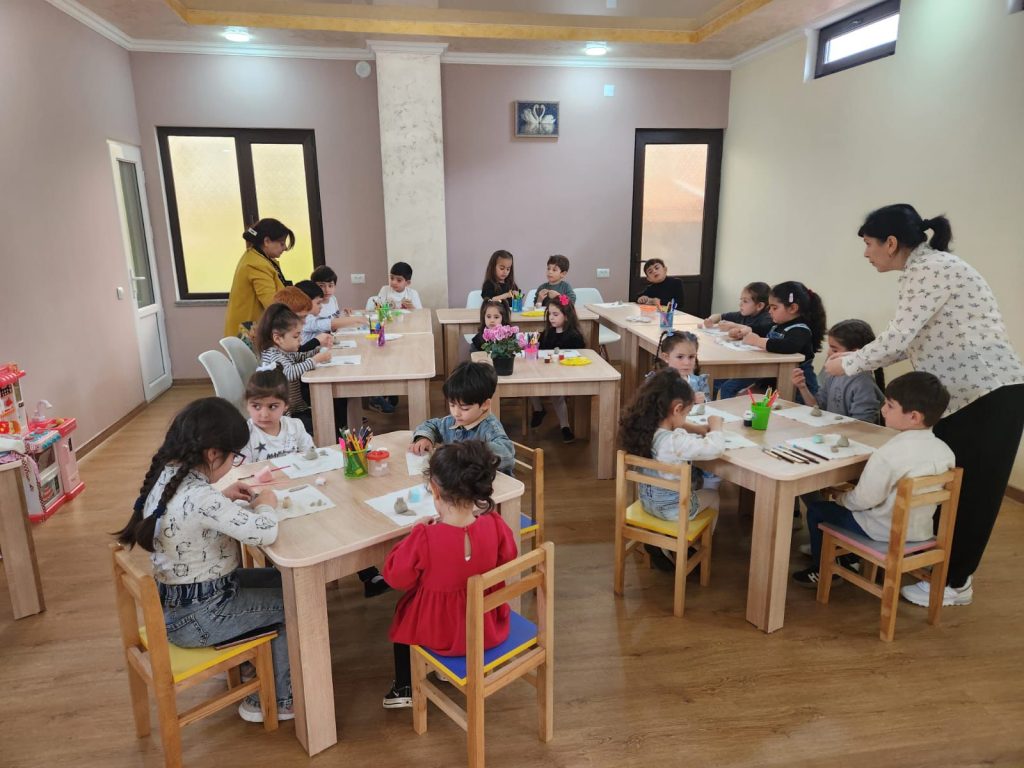
“We mostly purchased furniture and materials required for therapy, such as art therapy and sand therapy tables, clay-working tools, clay, sand, as well as other necessary supplies like pencils, pens, and paper. Additionally, we needed tables, chairs, and cabinets to set up the centre,” says Kristine.
Although 1.5 million AMD is a rather limited amount to start a business, the team constantly ran calculations and meticulously planned every step to stay within budget. However, it was impossible to fully realise the vision using only the grant support, so Kristine invested her own personal funds as well.
What makes the “ART Therapy” Centre unique?
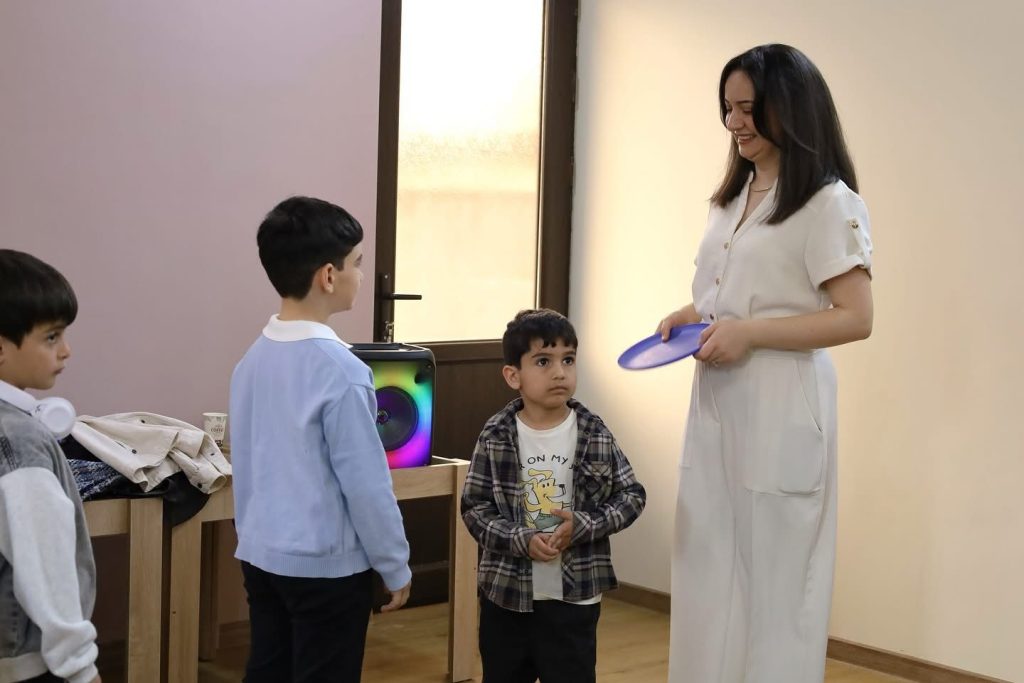
One of the primary pillars of the centre’s operations is art therapy – a method of psychological support and development where children are allowed to express their emotions, develop communication, social, and emotional skills, and overcome various challenges through diverse forms of art, including painting, pottery, sand therapy, creative games, and other expressive media.
The centre also conducts individual and group sessions aimed at child development and psychological support, carefully tailored to each child’s unique needs and characteristics.
Additionally, the centre collaborates with various local structures (e.g. National Centre for Mental Health Care) and specialists, contributing to the creation of an inclusive environment and raising awareness among parents. At the same time, the initiative provides opportunities for professionals in the field to get involved and gain practical experience, thereby fostering the growth of such services within the community.
Although there are various development centres and similar initiatives operating in Goris, this centre stands out due to its integration of art-therapeutic approaches and the individualised attention given to each child.
“Through creative work, we try to build essential skills in children and promote their psychological resilience and independence. Our goal is not just to keep children occupied, but to educate and develop them by creating a safe and supportive environment,” notes Kristine.
Sand therapy and pottery form the core of the centre’s daily activities. Children attend the centre according to a pre-scheduled timetable, participating in various sessions several times a week. At the same time, to ensure the programme goes beyond therapeutic work, the team also conducts general development and educational activities, providing an engaging and meaningful environment through games and creative methods.
Team, attendance, and programs
The centre has a small team, consisting of three specialists: Kristine as the psychologist, Kristine Grigoryan as the educator, and a nanny. The need for a nanny position arose because the centre is also open to toddlers, starting from 1.5 years old.
Children do not need to have psychological or developmental issues to attend the centre; the programmes offered are open to all children. However, in cases where a child has specific developmental or psychological needs, the team approaches their work with a personalised, individual strategy.
The sessions are primarily conducted in a group format. At the same time, Kristine prioritises ensuring an inclusive environment, aiming to structure activities in a way that fully integrates children with developmental challenges into group tasks, and does not make them feel isolated.
The centre runs various group programmes and initiatives. Since its opening, the “Summer School” programme has operated successfully, with around 35 children participating.
Another key initiative is the “To School” programme, designed for children aged 5-6. The goal of this programme was to prepare children for their new educational phase and to develop essential social, communication, and independence skills, with a particular focus on supporting children who had a specific need for it.
The centre provides a vital opportunity, especially for families in the Syunik region, as such specialised services are mostly concentrated in Yerevan and are often financially out of reach for many families. A portion of the children attending the centre benefit from the programmes free of charge, taking into account their families’ social and economic status.
To fulfil its social mission more effectively, the centre has already begun collaborating with state structures.
“I visited the Unified Social Service to present our centre and our activities. We explained that we operate as a social enterprise and want to support children with special needs. The collaboration process has already begun, and we plan to carry out broader work with the children in the near future,” shares Kristine.
Community changes and parent-child relationship
When speaking about the programme’s impact, Kristine particularly emphasises the changes taking place within the community, especially the strengthening of parent-child relationships. According to her, the centre aims to create an environment where parents and children become closer and more connected in a meaningful way.
“We organise meetings where parents come together with their children. This format is very well received because it allows parents to be directly involved in their child’s activities. It truly has a strong impact on strengthening the parent-child bond,” notes Kristine.
At the centre, children are given full freedom of self-expression, which contributes to the development of their confidence. These skills later help them both in school and in everyday communication. The team avoids a strictly directive approach; instead, children are encouraged to create and explore independently, gradually shaping more self-reliant and confident individuals.
At the same time, the centre carries out continuous behavioural observation. If any developmental particularities are identified that were not previously noticed, the psychologist holds a separate discussion with the parents and, when necessary, refers the child to relevant specialists, ensuring timely and targeted support.
Kristine also reflects on the lessons learned from her own experience and the mistakes made in the early stages of the initiative, emphasising that every new venture comes with challenges. Over time, she has learned the importance of maintaining a more balanced approach in certain situations. However, she stresses that the key is persistence and staying committed to one’s goal.
Vision for the future, expansion plans, and inspiring advice
Kristine’s goals go beyond developing the existing centre in Goris. She already has a clear vision to both strengthen the centre’s economic sustainability and expand its scope of activities. Among her upcoming plans is organising an exhibition-sale of the children’s pottery work, which will also serve as an additional source of financial stability for the centre.
Her long-term goals are even broader and more ambitious: Kristine aims to establish branches of the centre in various towns across Syunik and other regions of Armenia, building a larger network. In her vision, future centres will offer more diverse services, ranging from kindergarten-style formats to rehabilitative and therapeutic directions, including a physiotherapy component. Her ultimate goal is to create an environment where more children across different regions can receive high-quality and accessible support.
At the same time, Kristine emphasises that the power of an idea should never be limited by a lack of finances. Drawing from her own experience, she advises young people not to be held back solely by financial obstacles, but to first and foremost believe in their idea and consistently look for ways to bring it to life.
“Very often, people have ideas but stop because they think they don’t have the means. I always say: you don’t necessarily have to have the money at the beginning. The important thing is for the idea to live inside you and become a driving force. If you don’t live by it, it simply remains at the conceptual level. I lived with this idea myself for a long time, constantly searching for opportunities, options, and partners to make it a reality,” notes Kristine.
The “SKYE NET: Skills and Knowledge for Youth Empowerment” project, in which Kristine Aghabekyan participated, is implemented by World Vision Armenia with the financial support of the European Union, in partnership with IRIS Business Incubator, World Vision Georgia, and the Millennium Institute for Education and Development.
The EU4Youth Phase III Youth Employment and Entrepreneurship programme, co-funded by the European Union and the Ministry of Foreign Affairs of Lithuania, is being executed by the Central Project Management Agency (CPVA) in Eastern Partnership countries. These include Armenia, Azerbaijan, Belarus, Georgia, Moldova, and Ukraine. The programme will run until the middle of 2026 and aims to provide technical assistance to governmental and non-governmental organisations to tackle youth unemployment and improve employability.
The post Social entrepreneurship in Syunik: how Kristine Aghabekyan founded an art-therapy centre in Goris appeared first on EU NEIGHBOURS east.


